

Introduction: Where Skill Meets Psychology
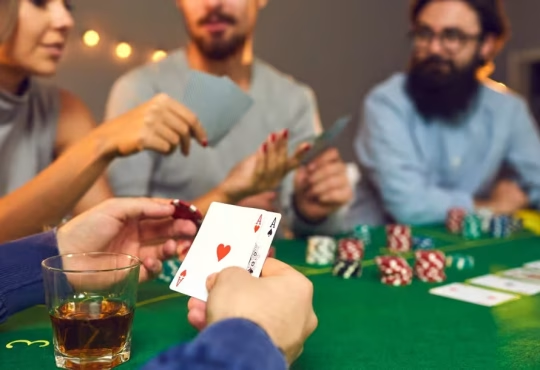
Poker, in all its forms, is more than a mere card game—it is a battle of wits, nerve, and calculated strategy. Unlike many games of chance, poker uniquely blends elements of probability, human psychology, and decision-making, turning each hand into a nuanced contest. Though often associated with smoky casino rooms or high-stakes televised tournaments, the game’s appeal runs far deeper. From humble home games to professional circuits, poker invites players into a world where discipline, patience, and intellect shape every move. It is not simply about the cards you are dealt but how you choose to play them.
The Origins and Evolution of Poker
The exact origins of poker remain somewhat debated among historians, yet most agree it traces its roots to early 19th-century America. The game evolved from various European predecessors, including the French game “poque” and the German “pochen,” both of which incorporated betting and bluffing. As poker made its way along the Mississippi River via riverboat gambling, it adapted and spread, eventually becoming an American institution.
Throughout the 20th century, poker saw waves of popularity, particularly with the rise of casino culture in Las Vegas. However, it was the early 2000s—bolstered by online platforms and televised tournaments such as the World Series of Poker—that transformed poker from a niche hobby into a global phenomenon.
Understanding the Game: Variants and Basics
While the term “poker” encompasses many game types, the most widely recognized variant is Texas Hold’em. Others, like Omaha, Seven Card Stud, and Five Card Draw, remain popular in both casual and competitive circles.
At its core, poker is about forming the best hand possible or convincing your opponents that you have one. Each game round typically involves:
-
Blinds or Antes: Forced bets that initiate action
-
Hole Cards: Private cards dealt to each player
-
Community Cards: Cards placed face-up for all to use (in Hold’em and Omaha)
-
Betting Rounds: Strategic intervals where players may bet, raise, call, or fold
-
Showdown: If multiple players remain after the final round, hands are revealed and the winner takes the pot
Though the mechanics are easy to learn, mastering poker demands far more than memorizing hands and rules.
Poker as a Strategic Discipline
The misconception that poker is purely luck-based couldn’t be further from the truth. While chance plays a role in the short term, skilled players consistently outperform novices over time, proving that poker is a game of informed decision-making.
Key strategic elements include:
-
Hand Selection: Knowing when to play and when to fold based on position and probability
-
Pot Odds and Expected Value: Calculating whether the risk is worth the potential reward
-
Reading Opponents: Interpreting subtle cues, betting patterns, and emotional tells
-
Bluffing: Convincing others you hold a stronger or weaker hand than you do, often a dance of psychology and timing
-
Table Position: Understanding the power of acting later in a betting round
A successful poker player thinks several moves ahead, constantly analyzing not only the cards but also the intentions and tendencies of their opponents.
The Psychological Edge: Poker as a Mind Game
More than most games, poker tests emotional resilience. It requires composure under pressure, especially during losing streaks or when bluffing under scrutiny. The term “tilt”—referring to a state of emotional frustration that leads to poor decision-making—is well-known in poker circles. Avoiding tilt, or recovering quickly from it, is often what separates seasoned players from amateurs.
Patience is equally vital. Many hands are folded before a player even sees the flop, and long periods of quiet strategy are punctuated by bursts of bold action. The ability to remain mentally engaged, even when not involved in the hand, is crucial.
Poker in the Digital Age
The arrival of online poker revolutionized the game, making it accessible to a global audience. No longer confined to casinos or kitchen tables, players can now test their skills against opponents from every corner of the world at any time of day.
Online platforms have introduced features such as:
-
Multi-tabling: Playing several games simultaneously
-
Tracking Software: Tools that analyze player performance over time
-
Training Programs: Advanced tutorials, simulations, and coaching platforms
This digital evolution also contributed to the infamous “Moneymaker Effect” in 2003, when Chris Moneymaker, an amateur who qualified via an online satellite tournament, won the World Series of Poker Main Event. His unexpected victory inspired countless others to take up the game, sparking a new poker boom.
The Culture and Community of Poker
Poker has developed a culture as rich as the game itself. There are poker celebrities, iconic tournaments, and even moments that have become legend in the poker community. Beyond the glitz of televised final tables, however, lies a community bonded by mutual respect, shared strategy discussions, and deep appreciation for the game’s intricacies.
Live tournaments, such as the European Poker Tour or the World Poker Tour, bring together players of all backgrounds. Many friendships are forged across the felt, and despite its competitive nature, poker often fosters a sense of fraternity among its most dedicated practitioners.
Ethics and Legality in Poker
As poker continues to grow, so too does the dialogue around responsible play and legality. Different countries have varied stances on online poker, with some regulating it tightly and others embracing its potential.
Ethical play is a core tenet among professionals. Cheating, collusion, or using unfair technological advantages are widely condemned and often punished. Many respected players advocate for transparency and fair regulation to preserve the integrity of the game.
Conclusion: The Timeless Allure of Poker
Poker is a game of infinite complexity wrapped in elegant simplicity. It challenges the intellect, hones the instincts, and reveals character in moments of tension. Unlike many pastimes, poker grows with its players—the more one learns, the deeper the game becomes.
For some, poker is a means of income. For others, it is a cerebral challenge or a social ritual. But for all who engage with it, poker offers something uniquely enduring—a chance to test oneself, to compete honestly, and to experience the thrill of strategy and serendipity dancing hand in hand.
In the end, poker is not just about winning money or mastering cards. It’s about mastering oneself.